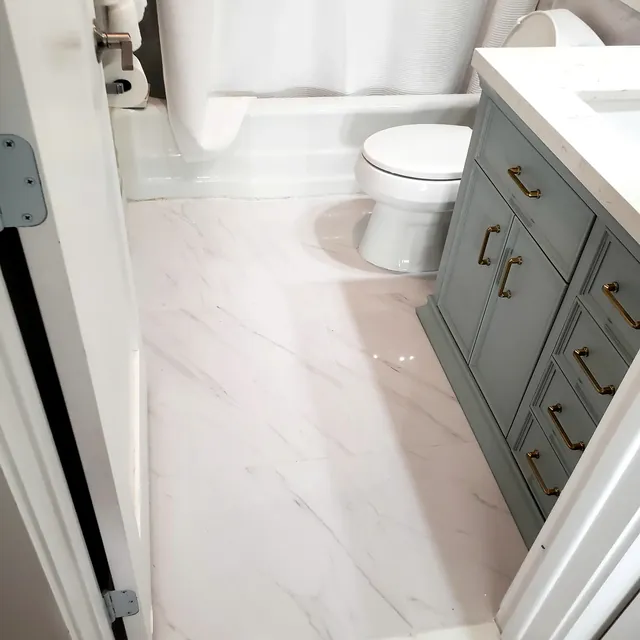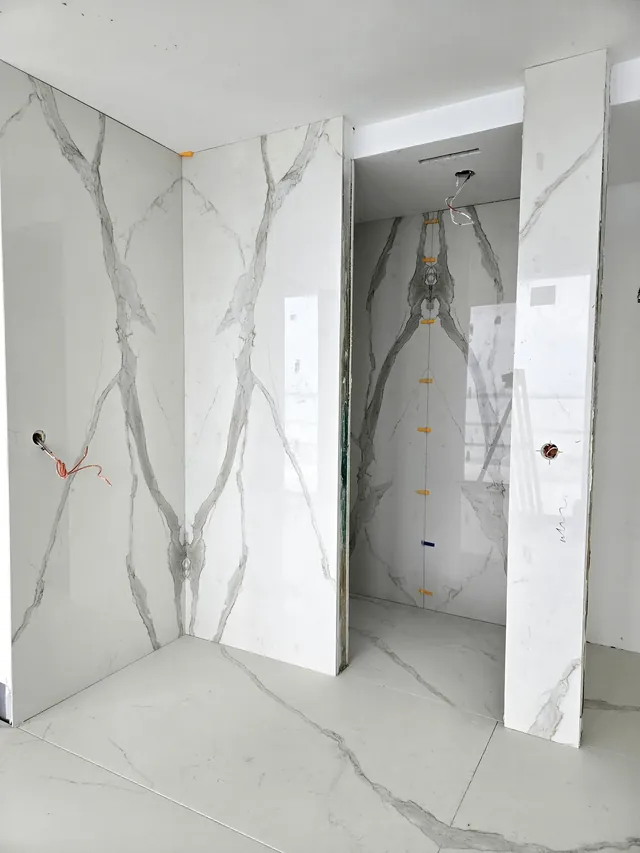
What our natural stone tile installation covers
The written quote lists each stone surface separately, because a polished marble floor and a honed limestone shower wall do not share the same preparation or finishing.
- Marble floor tile in bathrooms, entries, and living areas, with transitions to wood or carpet
- Stone wall tile on shower walls, tub surrounds, feature walls, and kitchen backsplashes
- Niches, curbs, thresholds, and sills in stone tile or matching pieces
- Stone mosaics on mesh, such as basketweave, herringbone, and hexagon
- Sealing of stone and grout where the stone maker calls for it
Inspecting and blending the stone before setting
Before mortar is mixed, we open the boxes, check the pieces against the approved sample, and dry-lay a representative run so you can see how the material reads in the room. A dry layout also exposes small cuts at walls and thresholds while the grid can still shift.
Pieces with cracks, chipped corners, open fissures, broken mesh, or missing travertine fill are set aside and reported. If the shipment does not match the sample, we stop and talk with the supplier before setting it.
Veining direction and blending
Veined marble can run one direction, rotate piece to piece, or be book-matched if it was cut in sequence for that. We agree on direction before setting and pull from several boxes at once so lighter and darker pieces spread through the room.
Substrate stiffness and flatness for stone
Stone is less forgiving of a floor that flexes. On wood-framed floors, the TCNA Handbook calls for natural stone to sit on a structure that deflects no more than L/720 under load, twice as stiff as the L/360 figure used for ceramic and porcelain tile. Our guide on floor deflection before tile explains what those numbers mean. If the framing does not meet the stone requirement, stiffening it is structural work for the appropriate trade, and the quote says so.
Most homes and condos here sit on concrete slabs, which are stiff but not always flat or crack free. Slab cracks can print through bonded stone, so cracks, high spots, and dips are checked and the preparation is written into the scope. Large stone tiles also need a flat plane to keep edges even.
Setting materials, cutting, grout, and joints
White mortar for light marble
Light marble such as white Carrara is slightly translucent. Gray mortar can show through as shadows, and some setting materials can stain light stone. We use a white mortar its maker rates for natural stone, with full coverage so trowel ridges do not ghost through.
Green marble and resin-backed stone
Many green marbles and some resin-backed tiles can curl, warp, or lose bond when they absorb water from an ordinary cement mortar. The stone maker usually specifies an adhesive for these, often an epoxy or a rapid-setting product, and we follow that instruction rather than substituting.
Cutting and edge finishing
Stone is cut wet with blades suited to the material. Polished stone shows saw marks on any exposed cut, so visible edges at niches, corners, and sills are planned in advance: an eased or polished edge, a matching trim piece, a miter, or a metal profile. Honed edges are easier to finish to match a matte face than polished ones.
Grout and movement joints
Stone is often set with narrow joints, and the grout is chosen for both the joint width and the surface, since coarse grout aggregate can scratch some polished stone. Movement joints still go at perimeters, changes of plane, and in the field where the TCNA Handbook calls for them, filled with a sealant instead of grout.
Sealing before grouting and acid sensitivity
Some porous or light stones can absorb grout color or haze during grouting. When the stone or grout maker calls for it, we apply a penetrating sealer or grout release before grouting and again after the grout cures, following the maker's dry times. Our tile and paver sealing page explains how sealer is assigned surface by surface.
Sealer reduces staining from absorbed liquids, but it does not stop etching. Marble, limestone, and travertine are calcium carbonate stones, so acids such as citrus, vinegar, wine, and many bathroom and grout cleaners can dull the surface on contact. Etching shows more on polished stone than on honed stone, which is one reason many people choose a honed finish for kitchens and busy bathrooms.
Marble-look porcelain or real stone
Many of our project photos show marble-look tile, which prints the look of stone onto a dense, low-absorption body. It does not etch and generally needs no surface sealer. Real marble offers depth and variation no print repeats, and asks for more care in return. Our large-format porcelain page covers the porcelain side, and the floor gallery shows marble-look work.
Living with natural stone
- Clean with a pH-neutral cleaner labeled for natural stone, and avoid vinegar, citrus, bleach, and abrasive powders.
- Wipe spills promptly, especially acidic ones, and use mats at entries to keep grit from scratching polished floors.
- Check sealer with a few drops of water: if the stone darkens quickly, it is absorbing and may be due for resealing per the maker.
- Expect natural variation and some patina over time; that is part of what stone is.
What shapes a stone installation quote
Stone quotes depend on the stone type and finish, tile size and pattern, floor or wall condition, framing or slab preparation, the specified adhesive, exposed edges and miters, sealing, and access. Waste allowances run higher for stone than porcelain, so we discuss who furnishes the material and how much extra to order.