What counts as large format
Under ANSI A108.02, large-format tile is any tile with at least one edge 15 inches or longer. That includes the common 24 by 48 inch floor tile, long plank tile, and the very large porcelain panels sold for walls, showers, and floors. The term covers a wide range, and the method changes as the size grows. A 24 by 24 inch floor tile and a panel taller than the person carrying it are both large format, but they are not handled the same way.
Handling and moving large panels
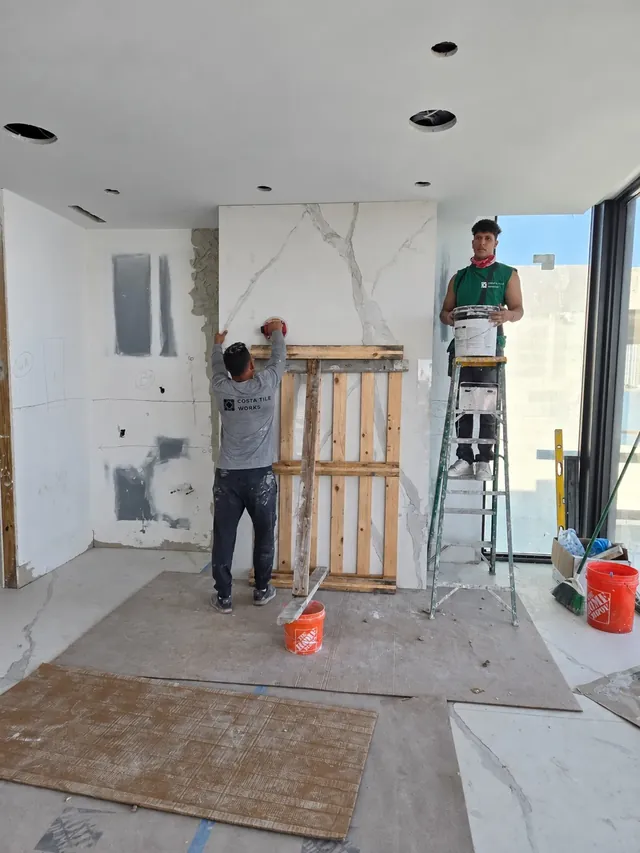
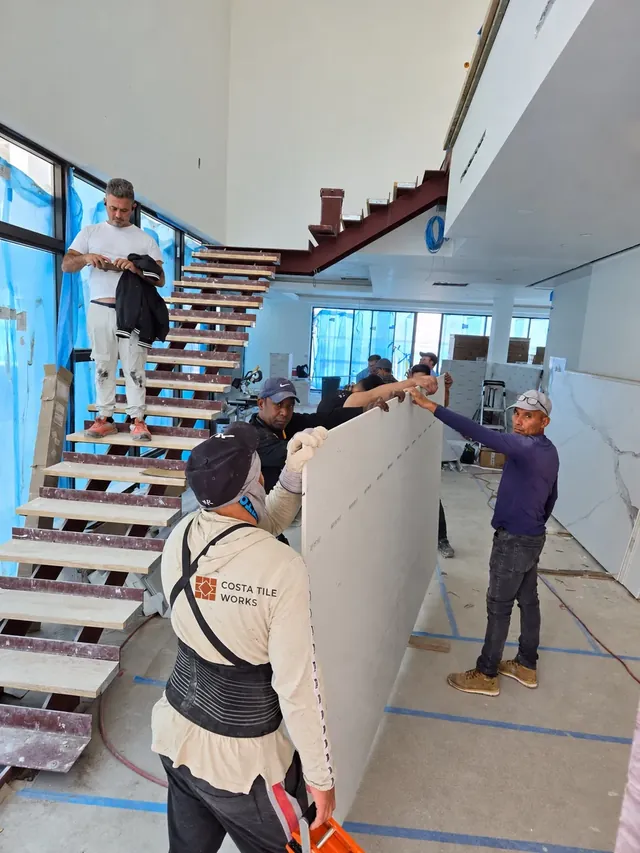
Large porcelain panels are heavy and can flex or crack when carried flat, so they are moved on edge by more than one person, with suction lifters on the face. The largest pieces are often carried on a rigid frame that keeps them from bending, and cuts are made on a fully supported surface. Our crew photos show a large-format panel being carried through an open interior and a large marble-look wall panel being set.
Access is part of the plan. We check the path from the delivery truck to the room: doorways, hallway turns, stairs, and in a high-rise, the elevator. Panels that do not fit in the elevator cab may need a different route or a smaller size. Building rules for deliveries, freight elevators, and work hours vary, so check with your building or association. Our condo tile installation page covers building logistics.
Substrate flatness
The industry flatness requirement for tile with any edge 15 inches or longer is no more than 1/8 inch variation in 10 feet and no more than 1/16 inch variation in 24 inches from the required plane. Standard tile allows more variation. Thinset is not meant to fix a wavy floor; as our thinset mortar guide explains, it follows the substrate. Floors and walls that are out of tolerance are corrected first, with a self-leveling underlayment on floors or wall flattening as needed.
We measure flatness before quoting where possible and write the preparation as a separate line, so you can see what the floor needs before tile. See why large tile needs a flatness line in the written scope.
Coverage and back-buttering
A large tile with hollow spots under it can crack under a point load or sound hollow when tapped. To prevent that, we use a setting mortar suited to large and heavy tile, a trowel sized for the tile, and back-butter the back of each tile with a thin layer of mortar before setting it. Trowel ridges are combed in one direction so air can escape as the tile is pressed down. Tiles are pulled during setting to check the mortar transfer. The tile and setting-material maker's instructions govern the mortar type and trowel.
Lippage and leveling systems
Lippage is the height difference between the edges of adjoining tiles. With large tile it shows clearly, especially under low-angle light from windows. Leveling clip systems hold neighboring edges in the same plane while the mortar cures and help reduce lippage, but they do not correct a substrate that is out of flat, and they cannot remove the natural warpage of the tile. Our lippage guide explains the limits.
Warpage and offset patterns
Large porcelain tiles are rarely perfectly flat; many have a slight bow along their length. In a 50 percent running bond, the high center of one tile lines up with the low ends of the next, which makes lippage worse. For that reason, industry guidance limits the offset to 33 percent for tiles with any side longer than 18 inches, unless the tile maker specifies otherwise. A 1/3 offset or a straight stack is the usual choice for large rectangular tile.
Book-matched layouts
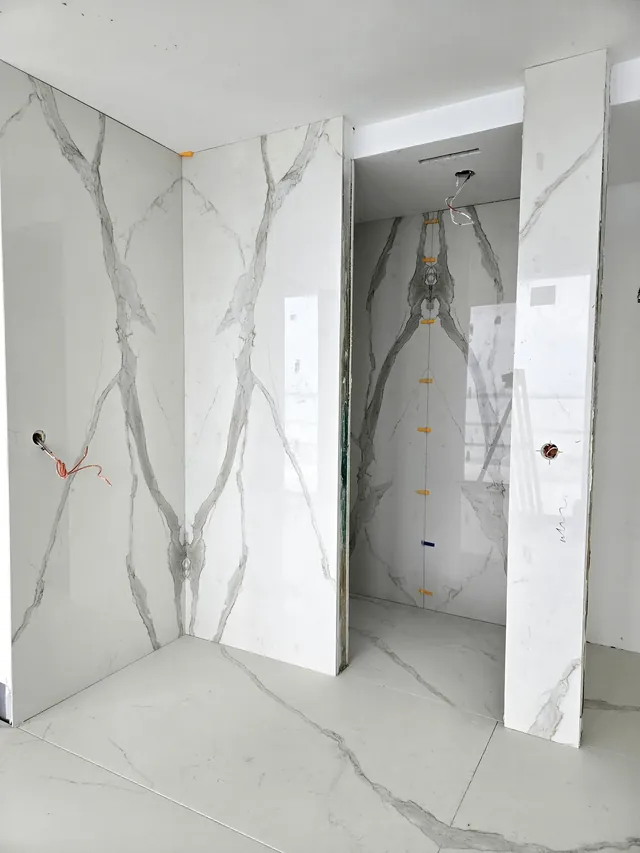
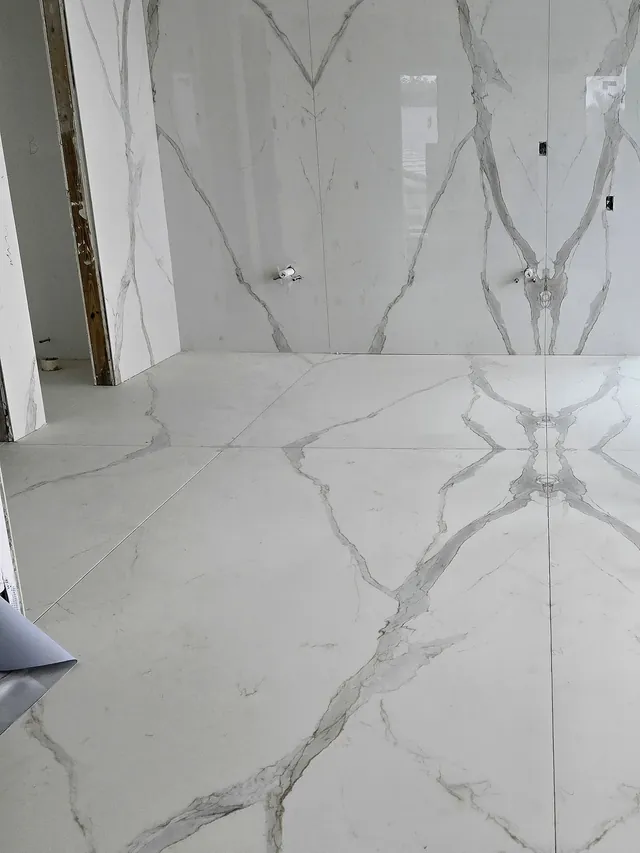
Some marble-look porcelain is printed in matched sets, so two neighboring panels mirror each other along a seam, like a book opened flat. Book-matching only works if each panel goes in its exact position. We lay out and label the panels before setting, check the sequence numbers from the maker, and confirm the seam location on the wall or floor. Waste and cut planning are different, because a cut panel cannot be swapped with any other. Our photos show book-matched marble-look panels on walls and floor.
Gauged porcelain panels
Thin porcelain panels are covered by their own standards: ANSI A137.3 for the product and ANSI A108.19 for installation. These panels come in thickness ranges, explained in our gauged porcelain thickness guide, and some have a reinforcing mesh on the back. They need specific mortar, coverage, handling, and cutting methods. The maker's instructions for the exact panel always govern, and some makers restrict which substrates and applications they accept.
Where large-format porcelain is used
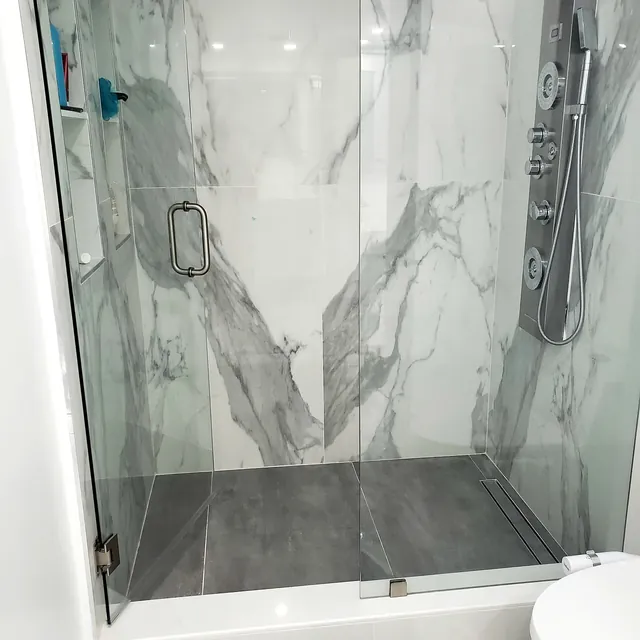
We set large-format tile on floors, shower walls, feature walls, and where a single material wraps from floor to wall. Substrate types, movement joints, and transitions for any tile floor are covered under floor tile installation. Large-format shower walls follow the same wet assembly planning as any tiled shower.
What affects a large-format quote
- Tile or panel size, thickness, and weight.
- How much substrate correction the floor or wall needs to meet flatness.
- The access path, including stairs, tight turns, and elevators.
- Book-matched or sequenced layouts that limit how panels can be cut.
- Floor versus wall installation, and edge profiles at exposed ends.