
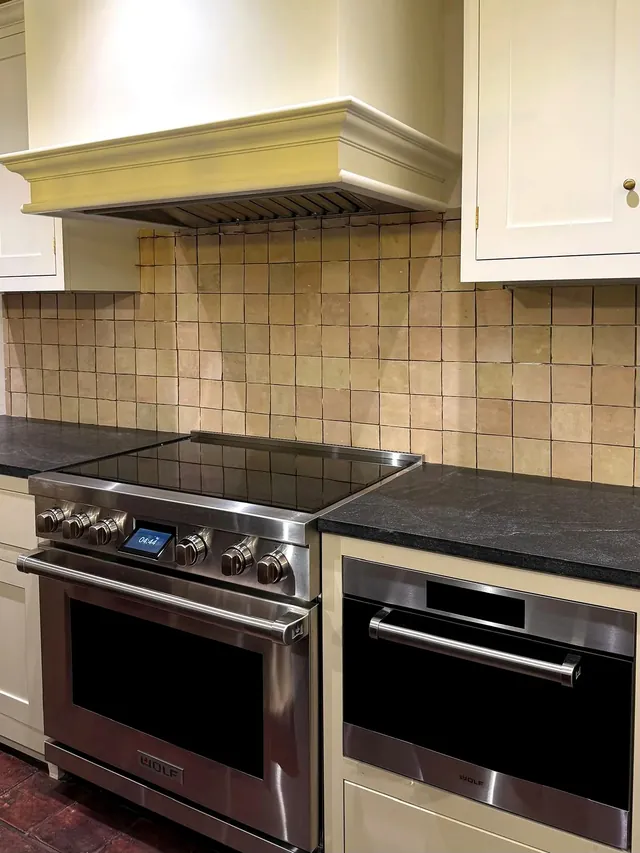
What changes when the tile is handmade
Machine-made porcelain is pressed to tight tolerances, so an installer can set it on a grid and expect it to line up. Handmade tile carries the marks of the person and the kiln that made it. Expect differences in:
- Thickness, which affects how each piece sits in the mortar and how flush neighboring tiles finish
- Face size and squareness, which affects joint width and how straight the courses read
- Color and glaze, which vary within a box and more between production runs
- Edges and surface, including chips, pits, crazing, or pinholes that makers describe as normal character
Character is not a defect, but it needs a plan
None of these traits is a flaw in the maker's eyes, and most buyers choose handmade tile for exactly this look. Each trait still has to be managed during setting. That is why specialty tile installation in South Florida starts with the actual tile in hand, opened and inspected, not with a drawing alone.
How we plan a handmade tile installation
The same five steps apply whether the tile is a glossy zellige square or a rough terracotta paver. The details inside each step change with the material.
Box blending
We open the boxes before setting and pull from several at once, so a darker run or a batch of thicker pieces does not end up concentrated in one patch of wall or floor. On a larger job that means staging the tile where it can be laid out and mixed.
Dry layout
Laying tile out dry shows where small cuts land, how the variation reads across the surface, and which pieces should go to corners or be set aside. Our guide on dry layout before adhesive explains why this step comes before any mortar is mixed.
Wider joints, or the maker's joint
Handmade tile often needs a wider grout joint than rectified porcelain to absorb size differences, although some zellige makers favor a tight joint. We never go below the maker's minimum and agree the joint with you before setting. See grout joint width for why it is a choice rather than one fixed size.
Sealing per maker
A fully glazed face generally does not need sealing. Cement tile, terracotta, unglazed clay, and some crazed glazes may need a sealer before grout, after grout, or both. The maker's care sheet decides the product and the order, and the quote names which surfaces get which treatment.
Overage and ordering
Handmade tile usually needs more overage than porcelain, because some pieces get culled for chips or color and patterns create extra cuts. Ordering, production, and shipping lead times are set by the supplier, not by us, so we plan our scope around when the material actually arrives. Keep a few spare pieces from the same lot for future repairs.
Zellige tile
Zellige is glazed terracotta from Morocco, cut by hand into squares, rectangles, and mosaic shapes. Its uneven thickness and glossy, pooled glaze are the point of the material and also its main installation challenge. Our zellige tile installation page covers back-buttering, blending, edge treatment, and where zellige suits a shower or backsplash.
Moroccan tile
The phrase Moroccan tile can describe three different products: patterned encaustic cement, chiseled zellige, or porcelain and ceramic printed with a Moroccan design. Each one installs differently. Read Moroccan tile installation to sort out which one you have.
Cement and encaustic tile
Encaustic cement tile has a pigmented cement face that is pressed and cured, not fired. It is porous until sealed and sensitive to grout pigment and acidic cleaners. See cement tile installation for sealing, grout testing, and pattern layout.
Terracotta and Saltillo
Unglazed clay pavers such as Saltillo are soft, absorbent, and irregular in size. They usually need wide joints and a sealer before grout. Our terracotta tile installation page explains interior floors, outdoor limits, and finish options.
Mosaic tile
Glass, marble, porcelain, and stone mosaics arrive on sheets of small pieces. The work is in hiding sheet lines and keeping the surface flat enough that small tiles do not show every dip. See mosaic tile installation.
Designer tile brands
Many customers buy from makers such as Clé, Zia, Fireclay, and Granada. We are an independent installer and set customer-supplied tile following the maker's instructions. The designer tile brands we install page groups each brand by the materials it sells.
Where handcrafted tile works in the house
Handmade tile is common on shower walls, kitchen backsplashes, bathroom walls, fireplaces, and floors where the maker rates the product for foot traffic. A wet area still needs a continuous waterproofing assembly behind the tile, built to the membrane maker's method, and your quote states which trade provides each layer. For floors, read the maker's use and slip information, not only the look.